Complete Guide to Redevelopment & Property Valuation Reports
Welcome to our blog! Today, we are going to talk about the Complete Guide to Redevelopment & Property Valuation Reports and why property valuation is important before starting a redevelopment project. Redevelopment can be a significant financial decision for property owners, housing societies, builders, and other stakeholders. Before signing a redevelopment agreement or negotiating with a developer, it is essential to understand the current market value and potential value of the property. A property valuation report for redevelopment provides a professional assessment based on important factors such as location, land area, existing building structure, property condition, prevailing market rates, development potential, and other relevant factors. A properly prepared valuation report by a qualified Registered Valuer can help stakeholders understand the property’s financial position, evaluate redevelopment proposals, negotiate more effectively with developers, and make informed decisions throughout the redevelopment process.
What Is Redevelopment Property Valuation?
Redevelopment property valuation is the professional process of assessing the value of a property that is being considered for redevelopment. It helps property owners, housing societies, developers, and other stakeholders understand the property’s current value and redevelopment potential before making important financial or contractual decisions.
Unlike a basic market-price estimate, a redevelopment valuation considers several property-related factors, such as:
- Land area and property location
- Existing building structure and construction
- Age and present condition of the property
- Current market conditions and prevailing property rates
- Development and redevelopment potential
- Permissible construction and applicable regulations
- Comparable property transactions in the surrounding area
- Existing rights, interests, and other relevant property considerations
The objective of a property valuation report for redevelopment is to arrive at a reasonable and supportable value based on the available property information, market evidence, and the appropriate valuation approach.
For property owners and housing societies, a professional redevelopment valuation report can provide a clearer understanding of the property’s financial position. It can also help them evaluate redevelopment proposals, compare offers, negotiate with developers, and make informed decisions before entering into a redevelopment agreement.
Why Is a Property Valuation Report Important for Redevelopment?
When a property is considered for redevelopment, understanding its actual financial value is one of the most important steps. A redevelopment project may involve additional construction area, compensation, rent, amenities, parking, commercial benefits, and other terms. Without a proper valuation, property owners or housing societies may find it difficult to understand whether a proposed redevelopment offer is reasonable.
A property valuation report for redevelopment provides a professional assessment of the property’s value by considering its location, land area, existing construction, condition, market conditions, development potential, and other relevant factors.
How Does a Valuation Report Help?
A professionally prepared valuation report can help property owners and housing societies:
- Know the Property’s Current Value
Understand the estimated value of the land, existing property, and other relevant components based on available market and property information. - Evaluate Redevelopment Offers
Review the financial and property-related benefits offered by a developer with a better understanding of the property’s value. - Strengthen Negotiations
A professional valuation can provide useful financial information when discussing terms and benefits with developers. - Compare Different Proposals
If multiple developers submit proposals, valuation information can help stakeholders make a more informed comparison. - Support Better Decision-Making
A clear understanding of property value allows owners and societies to assess redevelopment options more carefully before entering into an agreement.
Is the Valuation Report the Final Redevelopment Value?
No. A property valuation report does not by itself decide the final redevelopment agreement or terms. It is a professional assessment that provides relevant financial and property information. The final redevelopment terms may depend on negotiations, legal considerations, development permissions, project feasibility, and the agreement between the concerned parties.
Therefore, obtaining a suitable redevelopment property valuation report can be an important step toward understanding the property’s financial position and making informed redevelopment decisions.
Who Needs a Property Valuation Report for Redevelopment?
A property valuation report for redevelopment can be useful for different people and organisations involved in a redevelopment project. The report helps them understand the property’s estimated value and provides relevant information for financial planning, evaluation, and negotiations.
Who Can Benefit from a Redevelopment Valuation Report?
- Individual Property Owners:
Property owners can use a valuation report to understand the value of their property before discussing redevelopment terms with a developer. - Apartment or Housing Society Members:
Members can use professional valuation information to better understand the financial aspects of a proposed redevelopment project. - Co-operative Housing Societies:
|A valuation report can provide useful property-related information when reviewing developer proposals and discussing redevelopment terms. - Property Investors:
Investors can use valuation information to assess the financial potential and redevelopment prospects of a property. - Landowners:
For landowners, valuation can help establish an understanding of the land’s value and its potential in a redevelopment project. - Developers and Project Stakeholders:
Developers and other project stakeholders may require valuation information for project planning, financial assessment, and understanding the property’s development potential. - Institutions and Organisations:
Organisations holding properties that are proposed for redevelopment may also require professional valuation documentation for assessment and decision-making purposes.
Role of a Registered Valuer in Redevelopment
A Registered Valuer plays an important role in professionally assessing the value of a property proposed for redevelopment. The valuation is generally based on the property’s characteristics, available documents, market conditions, development potential, and the purpose of the assignment.
- Reviews the property documents and information provided by the owner, society, or concerned stakeholder.
- Understands the purpose, scope, and requirements of the property valuation before starting the assessment.
- Conducts a physical inspection of the property, where required, to understand its location, existing construction, condition, and other relevant characteristics.
- Studies the local property market, prevailing market conditions, and comparable transactions relevant to the valuation.
- Considers important factors such as land area, location, existing building, age and condition, development potential, permissible construction, and applicable requirements.
- Selects and applies an appropriate valuation approach or methodology based on the nature and purpose of the assignment.
- Analyses the available property information and relevant market evidence to arrive at a reasonable and supportable valuation.
- Prepares a property valuation report for redevelopment containing relevant findings, valuation details, assumptions, and supporting information.
- The exact scope, methodology, inspection requirements, and documentation may vary depending on the type of property, purpose of valuation, applicable requirements, and information available to the valuer.
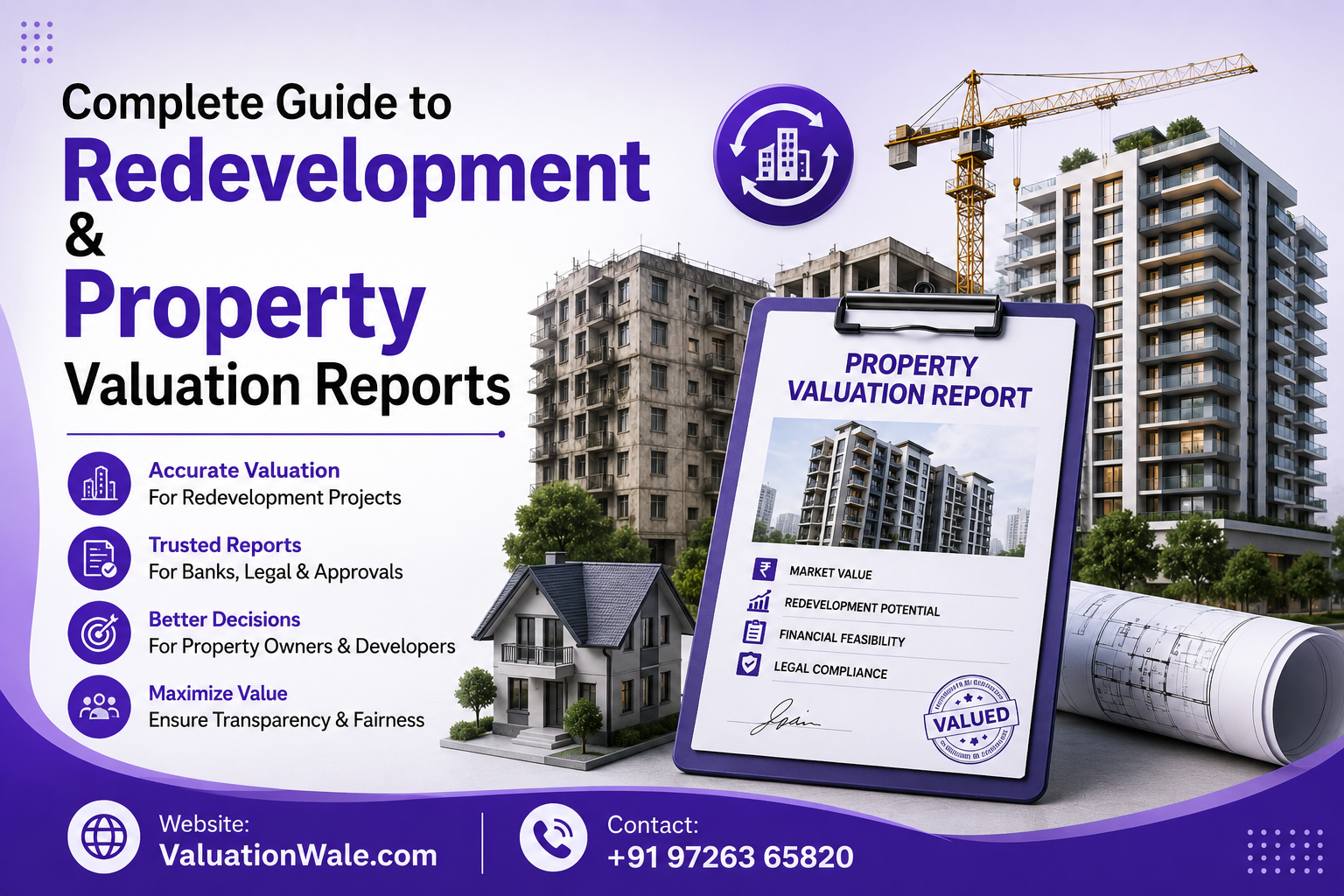
Documents Required for Redevelopment Property Valuation
For preparing a property valuation report for redevelopment, the Registered Valuer may require documents related to ownership, land, existing construction, approvals, and the proposed redevelopment. The exact requirements can vary depending on the property and purpose of valuation.
Commonly Required Documents:
- Sale Deed / Title Deed
- Property Ownership Documents
- Property Card / Land Records
- Latest Property Tax Receipt
- Approved Building Plan
- Approved Layout Plan
- Building Permission / Development Permission
- Completion Certificate / Occupancy Certificate, if available
- Details of Existing Construction
- Previous Property Valuation Report, if available
- Society Registration & Society Documents, where applicable
- Society Share Certificate, where applicable
- Redevelopment Proposal / Developer Offer
- Existing or Proposed Redevelopment Agreement, if available
- Development Plan and Related Permissions
- Survey Plan / Site Plan, where applicable
- Details of Land Area and Built-up Area
- Any Other Property-Related Documents Requested by the Registered Valuer
Providing complete and accurate documents can help the Registered Valuer assess the property more efficiently and prepare a reliable redevelopment property valuation report based on the available information.
Property Valuation Process for Redevelopment
The property valuation process for redevelopment involves a systematic assessment of the property’s value based on its documents, physical characteristics, market conditions, and development potential. While the exact process may vary depending on the property and purpose of valuation, the general process can be explained in the following six steps:
Step 1: Understand the Valuation Requirement
First, the purpose of the valuation is identified. The Registered Valuer understands whether the report is required for redevelopment planning, negotiations, financial assessment, documentation, or another specific purpose.
Step 2: Collect and Review Property Documents
Relevant documents such as title deeds, ownership records, approved plans, property tax records, building permissions, society documents, and redevelopment-related papers are collected and reviewed.
Step 3: Inspect the Property
Where required, the Registered Valuer conducts a physical inspection to assess the property’s location, existing construction, condition, size, accessibility, and other relevant physical characteristics.
Step 4: Analyse Market & Development Factors
The valuer studies prevailing market conditions, comparable property transactions, location advantages, land area, existing construction, development potential, permissible construction, and other relevant factors.
Step 5: Determine the Property Value
After analysing the available information, the Registered Valuer applies an appropriate valuation approach and assesses the property’s value based on the purpose and scope of the assignment.
Step 6: Prepare the Property Valuation Report
The final property valuation report for redevelopment is prepared with relevant property details, valuation findings, assumptions, methodology, supporting information, and the valuation conclusion.
Factors Affecting Redevelopment Property Value
The value of a property considered for redevelopment depends on several factors rather than a single element. A property valuation report for redevelopment may consider the property’s physical characteristics, location, market conditions, development potential, and other relevant property interests.
1. Property Location
The location of the property, connectivity, surrounding infrastructure, nearby facilities, and overall development of the area can influence its value.
2. Land Area and Plot Characteristics
The total land area, plot dimensions, shape, access, and other site characteristics may have an important impact on the property’s valuation.
3. Existing Building and Construction
The age, type, quality, condition, built-up area, and existing use of the building may be considered as part of the valuation assessment.
4. Current Market Conditions
Prevailing property prices, demand and supply, comparable transactions, and market trends in the relevant location can influence the assessed value.
5. Redevelopment Potential
The property’s potential for redevelopment, including the available development opportunities and relevant development parameters, may affect its overall value.
6. Permissible Development and Regulations
Applicable planning rules, development permissions, construction restrictions, and other regulatory requirements can influence the property’s development potential.
7. Property Rights and Interests
Ownership structure, existing rights, interests, encumbrances, restrictions, and other relevant property-related matters may need to be considered during valuation.
8. Property-Specific Circumstances
Every redevelopment property is different. Therefore, the Registered Valuer considers the factors that are relevant to the specific property, valuation purpose, available information, and scope of the assignment.
Benefits of a Property Valuation Report
A professionally prepared property valuation report for redevelopment can give property owners and housing societies valuable information before making financial or redevelopment-related decisions. Some key benefits include:
1. Clear Understanding of Property Value
Helps property owners get a professional assessment of the property’s value based on relevant property and market information.
2. Better Evaluation of Redevelopment Options
Provides useful valuation information when reviewing redevelopment proposals, benefits, and financial terms.
3. Stronger Basis for Negotiation
An independent valuation can provide supporting information during discussions and negotiations with developers.
4. Reliable Valuation Record
Creates professional documentation showing the relevant information, methodology, assumptions, and valuation conclusion for the assigned purpose.
5. Greater Transparency Among Stakeholders
A structured valuation can help property owners, society members, and other stakeholders understand how relevant factors may affect the property’s value.
6. Helps With Financial Planning
Understanding the property’s estimated value can assist owners and societies in assessing potential financial outcomes and planning for the redevelopment process.
Get Professional Property Valuation Support for Your Redevelopment Project
Planning a redevelopment project requires a clear understanding of the property’s value before entering into negotiations or finalising important terms. A professionally prepared property valuation report for redevelopment can help property owners, housing societies, landowners, and other stakeholders assess the property’s value, understand relevant market factors, and make informed decisions. Our valuation professionals provide reliable and purpose-specific property valuation services based on the property’s location, characteristics, available documents, market conditions, and applicable valuation requirements.
Get in touch with our valuation experts today for professional guidance and a detailed property valuation report tailored to your redevelopment requirements.
🌐 Website: ValuationWale.com
📞 Contact: +91 97263 65820