Property Valuation Report vs Property Appraisal
Welcome to our blog! Today, we will discuss Property Valuation Report vs Property Appraisal, one of the most common topics in the real estate industry. Whether you are buying a property, selling real estate, applying for a home loan, planning an investment, handling taxation matters, or managing legal documentation, understanding the difference between a Property Valuation Report and a Property Appraisal is essential. Although both are used to determine a property’s value, they differ in terms of purpose, accuracy, methodology, legal acceptance, and the professionals who prepare them. A Property Valuation Report provides a detailed and reliable assessment of a property’s value for official and financial purposes, while a Property Appraisal offers an estimated market value that helps buyers, sellers, and investors make informed decisions. In this comprehensive guide, we will explain the key differences, benefits, uses, and importance of Property Valuation Reports and Property Appraisals so you can choose the right option for your specific real estate needs.
What Is a Property Valuation Report and Property Appraisal?
Property Valuation Report
A Property Valuation Report is a detailed and professionally prepared document that determines the fair market value of a property. It is typically prepared by a qualified property valuer, registered valuer, or chartered engineer after conducting a thorough inspection and analysis of the property. The valuation process considers factors such as the property’s location, land area, built-up area, age, condition, construction quality, legal ownership status, market trends, comparable property sales, and future development potential. Due to its comprehensive nature, a property valuation report is widely used for home loans, mortgage applications, income tax calculations, capital gains assessments, net worth certificates, financial reporting, business transactions, property disputes, and court-related matters. Because it is supported by professional analysis and documentation, it is generally considered highly reliable and legally acceptable for official purposes.
Property Appraisal
A Property Appraisal, on the other hand, is an estimate of a property’s current market value based on prevailing real estate conditions. It is commonly conducted by real estate agents, brokers, lenders, or appraisal professionals to determine a likely selling price or market value. Property appraisals primarily focus on recent sales of similar properties, local market demand, neighborhood conditions, property features, and current market trends. They are frequently used for buying and selling decisions, listing price recommendations, mortgage lending evaluations, investment analysis, and general market assessments. While an appraisal can provide a useful indication of a property’s value, it is usually less detailed than a Property Valuation Report and may not carry the same level of legal validity for taxation, litigation, or other official requirements. Property appraisals are generally quicker and less formal, making them useful for estimating market value rather than official legal or financial purposes.
Property Valuation Report vs Property Appraisal: Key Differences Explained
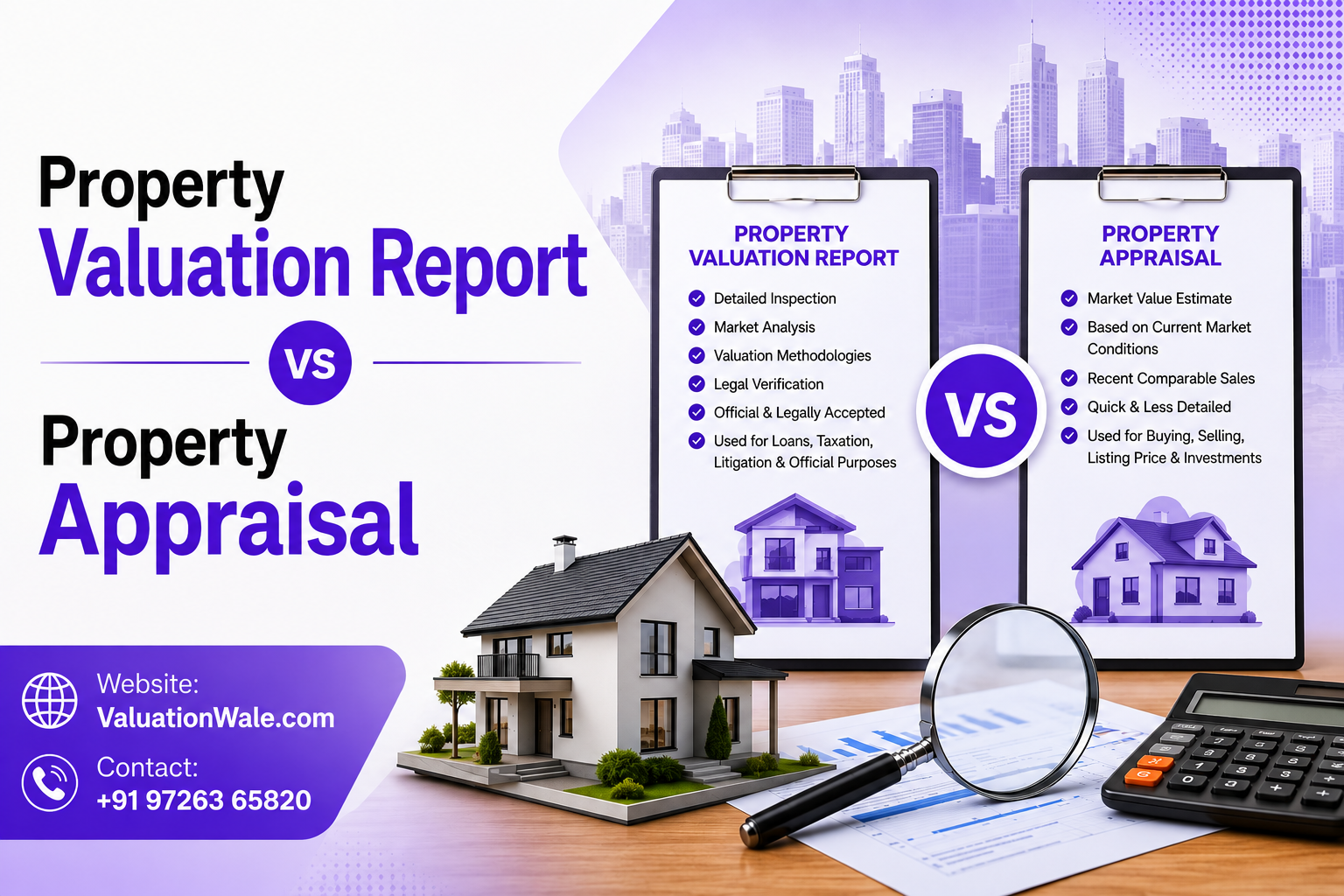
While both a Property Valuation Report vs Property Appraisal help determine the value of a property, they are designed for different purposes and offer different levels of accuracy and detail. A Property Valuation Report is a formal and professionally prepared document that is often required for legal, financial, taxation, and lending purposes. In contrast, a Property Appraisal provides an estimated market value that helps property owners, buyers, sellers, and investors understand a property’s likely selling price in the current real estate market. Understanding the differences between these two methods can help you choose the right option based on your specific requirements.
| Feature | Property Valuation Report | Property Appraisal |
|---|---|---|
| Meaning | A detailed report that determines the fair market value of a property through professional inspection and analysis. | An estimated market value of a property based on current real estate market conditions. |
| Primary Purpose | Used for legal, financial, taxation, loan, and compliance-related purposes. | Used to estimate a property’s selling price and support real estate decisions. |
| Prepared By | Registered Valuer, Chartered Engineer, Government-Approved Valuer, or Qualified Valuation Professional. | Real Estate Agent, Broker, Appraiser, Lender, or Market Professional. |
| Level of Detail | Includes property inspection, market analysis, legal verification, valuation methods, and supporting data. | Primarily focuses on market trends, property features, and comparable sales. |
| Valuation Method | Uses professional valuation approaches such as market, cost, and income methods. | Usually relies on recent sales of similar properties and local market conditions. |
| Property Inspection | Detailed physical inspection is generally conducted. | Inspection may be limited or less comprehensive. |
| Legal Validity | Widely accepted for legal proceedings, taxation, financial reporting, and official submissions. | Generally not accepted as a standalone legal valuation document. |
| Accuracy | Higher accuracy due to detailed analysis and professional valuation standards. | Accuracy depends largely on market conditions and available comparable properties. |
| Documents Considered | Reviews ownership records, title documents, property details, approvals, and other supporting documents. | Usually focuses on property characteristics and market data. |
| Common Uses | Home loans, mortgage applications, net worth certificates, tax planning, business transactions, property disputes, and court matters. | Property buying, selling, listing price recommendations, investment decisions, and market assessments. |
| Cost | Typically higher due to the detailed evaluation process. | Usually lower than a professional valuation report. |
| Best For | Individuals, businesses, lenders, courts, and authorities requiring an official property value. | Buyers, sellers, investors, and real estate professionals seeking a quick market estimate. |
Choosing between a Property Valuation Report and a Property Appraisal depends on your objective. If you need an officially recognized property value for loans, taxation, legal matters, or financial reporting, a Property Valuation Report is generally the better choice. However, if you simply want to understand the current market value of a property before buying, selling, or investing, a Property Appraisal may be sufficient.
Who Can Prepare a Property Valuation Report or Property Appraisal?
The credibility, accuracy, and acceptance of a property value assessment largely depend on the qualifications and expertise of the professional preparing it. While both Property Valuation Reports and Property Appraisals help estimate a property’s value, they are typically prepared by different professionals and serve different purposes.
| Assessment Type | Who Can Prepare It? | Typical Purpose |
|---|---|---|
| Property Valuation Report | Registered Valuer, Chartered Engineer, Government-Approved Valuer, Qualified Valuation Professional, or Professional Valuation Firm | Used for home loans, taxation, financial reporting, net worth certificates, legal disputes, business transactions, and court-related matters. |
| Property Appraisal | Real Estate Agent, Property Broker, Appraisal Professional, Lending Institution, or Real Estate Consultant | Used for property buying and selling decisions, listing price recommendations, market analysis, and investment planning. |
A Property Valuation Report is generally prepared by qualified professionals who follow established valuation standards and conduct detailed property inspections, market analysis, and document verification. Because of its professional and comprehensive nature, it is widely accepted by banks, financial institutions, government authorities, courts, and tax departments.
A Property Appraisal, on the other hand, is often prepared by real estate professionals who assess a property’s likely market value based on recent sales, local demand, neighborhood trends, and comparable properties. While appraisals are useful for understanding current market conditions, they may not always be accepted for official legal, taxation, or financial purposes.
If you require a property value for a loan application, tax compliance, financial reporting, legal proceedings, or other official requirements, a Property Valuation Report prepared by a qualified professional is generally the preferred and more reliable option.
How Are Property Valuation Reports and Property Appraisals Conducted?
Although both methods are used to determine a property’s value, the process followed for a Property Valuation Report is generally more detailed and comprehensive than a Property Appraisal. The table below highlights how each process is conducted, making it easier to understand the differences.
| Process Stage | Property Valuation Report | Property Appraisal |
|---|---|---|
| Step 1: Property Inspection | Detailed physical inspection of the property, including land, building, construction quality, condition, and amenities. | Basic review of the property’s condition, features, and overall appeal. |
| Step 2: Location Analysis | Evaluates location, accessibility, infrastructure, zoning, and future development potential. | Reviews neighborhood attractiveness and local market demand. |
| Step 3: Market Research | Studies market trends, economic factors, and comparable property sales. | Focuses mainly on recent sales of similar properties. |
| Step 4: Land & Building Assessment | Separately assesses land value and building value where applicable. | Usually does not perform a detailed land and building valuation. |
| Step 5: Valuation Methodology | Uses professional valuation approaches such as Market Approach, Cost Approach, and Income Approach. | Primarily relies on the Market Comparison Approach. |
| Step 6: Legal Document Review | Verifies ownership records, title documents, approvals, and legal status of the property. | Legal document verification is generally limited or not included. |
| Step 7: Financial Analysis | May include income potential, rental value, depreciation, and replacement cost analysis. | Typically focuses on current market value rather than financial analysis. |
| Step 8: Final Value Determination | Determines the property’s fair market value based on multiple factors and valuation methods. | Estimates the property’s likely selling price based on market conditions. |
| Step 9: Report Preparation | Provides a detailed valuation report with supporting calculations, observations, and professional conclusions. | Provides a market value estimate or appraisal summary. |
Key Takeaway: A Property Valuation Report follows a structured and detailed process involving inspection, market analysis, legal verification, and professional valuation methods. A Property Appraisal is generally a quicker market-based assessment focused on estimating a property’s current selling price. As a result, valuation reports are usually more accurate and widely accepted for legal, financial, taxation, and lending purposes.
When Do You Need a Property Valuation Report or Property Appraisal?
The choice between a Property Valuation Report and a Property Appraisal depends on your specific purpose and the level of accuracy or legal acceptance required. A Property Valuation Report is generally recommended when an official and professionally supported property value is needed for home loan and mortgage applications, property taxation matters, capital gains calculations, net worth certificates, wealth assessments, property partition cases, court disputes, business asset valuation, financial reporting, auditing, and insurance assessments. Because it is prepared by qualified professionals using established valuation methods, it provides a reliable and legally acceptable assessment of property value.
A Property Appraisal, on the other hand, is more suitable when you need a quick estimate of a property’s current market value for practical decision-making. It is commonly used when buying or selling a property, determining an appropriate listing price, evaluating real estate investment opportunities, supporting mortgage approval decisions, or analyzing local market trends. While a property appraisal can help buyers, sellers, and investors understand current market conditions and likely selling prices, it is generally less detailed and may not be accepted for official legal, taxation, or financial purposes. Choosing the right option ensures that you obtain the level of valuation accuracy and documentation required for your specific real estate needs.
Can a Property Appraisal Replace a Property Valuation Report?
A common question among property owners, buyers, and investors is whether a Property Appraisal can replace a Property Valuation Report. While both are used to estimate a property’s value, they serve different purposes and are not always interchangeable.
A Property Appraisal is primarily designed to provide an estimate of a property’s current market value. It is commonly used when buying or selling real estate, setting a listing price, evaluating investment opportunities, or understanding local market trends. For these purposes, an appraisal may provide enough information to support decision-making.
However, a Property Valuation Report is generally required when an official, legally recognized, or professionally verified property value is needed. Banks, financial institutions, courts, government authorities, tax departments, and insurance companies often rely on valuation reports because they include detailed property inspections, market analysis, valuation methodologies, legal document verification, and supporting evidence.
As a result, a Property Appraisal may be sufficient for informal real estate decisions, but it cannot fully replace a Property Valuation Report for home loans, taxation matters, capital gains calculations, net worth certificates, financial reporting, business valuations, property disputes, or court proceedings.
The key difference is that a Property Valuation Report vs Property Appraisal provides a comprehensive and professionally supported assessment of value. Therefore, whether an appraisal can replace a valuation report ultimately depends on the purpose of the transaction and the requirements of the institution requesting the property value.
Your Trusted Partner for Property Valuation Reports and Property Appraisals
Understanding the difference between a Property Valuation Report and a Property Appraisal is essential when making important real estate decisions. While both help estimate a property’s value, the right option depends on your specific purpose, whether it is for buying, selling, financing, taxation, legal compliance, financial reporting, or investment planning. A professional property valuation report provides a detailed and reliable assessment, helping property owners, buyers, lenders, and investors make informed decisions with greater confidence.
Our experienced property valuers provide accurate and reliable valuation reports for residential, commercial, industrial, and agricultural properties across India. Whether you need a property valuation report for official purposes or professional guidance on understanding your property’s market value, we can help you choose the right solution and determine the true value of your property.